
A license logo in a casino footer looks like a promise. Most players treat it as one, then learn too late that not all licenses mean the same thing. A Malta seal and a Curacao seal can sit side by side in the same footer and deliver wildly different protection the moment a payout goes wrong. That gap is the whole story.
This guide has casino licenses compared by the one measure that matters to a player: who can force the casino to pay you, and what they will actually do about it. You get a clear protection tier list, a two-minute way to check any license is real, and the honest recourse you hold under each one. For the fundamentals first, our casino licenses explained guide covers the basics.
Quick answer: with casino licenses compared by player protection, the UK Gambling Commission and the Malta Gaming Authority sit at the top, because both can order a casino to pay and punish it if it refuses. Gibraltar and the Isle of Man form a strong second tier. Curacao became a real regulator after its 2024 reform, though it is still mid-transition. Anjouan and registration-only setups offer the least. A license only counts if its number is live on the regulator’s public register, so always check before you deposit.
What a Casino License Actually Buys You
Strip away the branding and a license answers one question. If this casino refuses to pay your withdrawal, who steps in, and can they make it pay?
A License Is a Recourse Promise, Not a Quality Badge
A license is not a seal of quality. It is a line of recourse. A strong regulator gives you a named complaints body, the power to freeze or pull the operator’s license, and a track record of ordering payouts. A weak one gives you a logo and little else. Judging a casino license by how strict it sounds misses the point. What matters is whether anyone with real power stands behind it when your money is stuck. That is casino licenses compared by recourse, not by reputation, and it is the test that sorts the tiers you are about to see.
The Four Things a License Should Enforce
Every license worth trusting enforces four things. Player fund protection keeps your balance safe if the casino goes under. Game fairness testing confirms the RNG and RTP are genuine, the engine explained in how online slots work and audited the way our RTP guide describes. Dispute resolution gives you a route when support stalls. Identity and anti-money-laundering rules keep the platform clean. Strong regulators mandate and audit all four, and the same fairness checks answer the are online slots rigged worry for good. Weak regulators leave most of it optional, which is exactly where players get burned.
Why Two Casinos With the Same License Differ
A license sets the floor, not the ceiling. Two casinos under the same regulator can behave very differently, because the operator still controls payout speed, support quality, and how strictly it reads its own bonus terms. A Malta license does not guarantee fast cashouts, and a strong operator on a weaker license can still treat you well. The license tells you what recourse exists. The operator’s own record, checked through reviews and our trustworthy operator guide, tells you how often you will need it.
Casino Licenses Compared by Player Protection
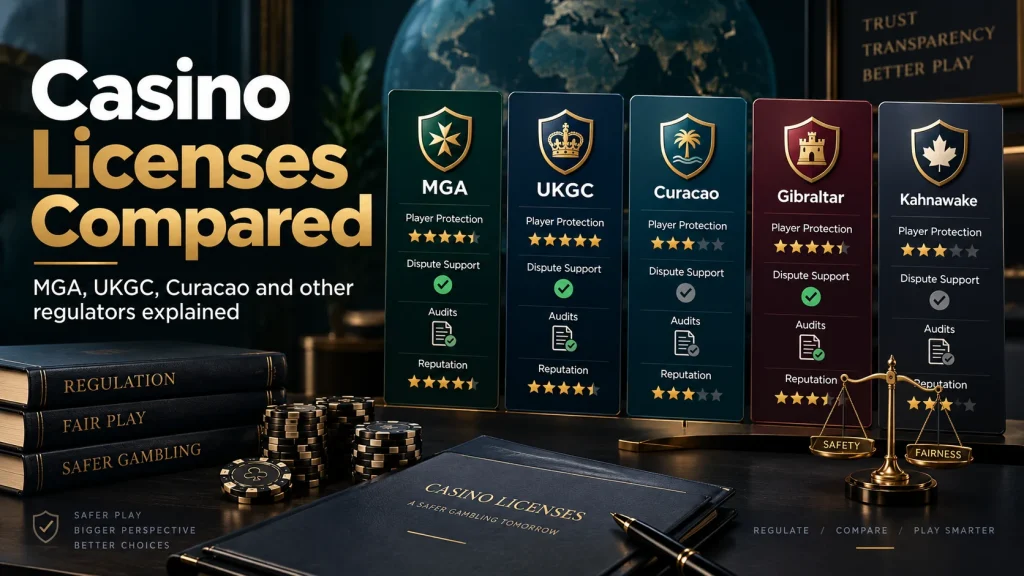
Here is the part most guides get wrong. They rank licenses by reputation and stop there. This tier list ranks them by what you actually get when something breaks, from full enforced recourse down to almost none. Seeing casino licenses compared this way changes which seal you trust. The pyramid shows the shape: the strongest protection is the narrowest and least common, and the widest base is where you carry the most risk yourself.
Tier 1: UKGC and Malta (Enforced Recourse)
The UK Gambling Commission is the strictest regulator for players in its market, and its 2025 rules went further than any other. Online slot stakes are capped at 5 pounds a spin for players 25 and over, and 2 pounds for those aged 18 to 24. Financial vulnerability checks trigger once net deposits pass 150 pounds in 30 days, bonus wagering is capped at 10x, and every new player must set a deposit limit before funding an account.
If a UKGC casino refuses a fair payout, you get a binding complaints route and a regulator that fines and suspends operators. The Malta Gaming Authority delivers the same enforced recourse for the wider European market.
The two top regulators guard your funds differently. Malta requires operators to keep player money segregated and separately identifiable. The UKGC instead forces every operator to disclose its fund-protection level at your first deposit, across four bands from none to high, so you know the risk before you commit. The 10x bonus cap is unpacked in our bonus terms and promotions guides.
Tier 2: Gibraltar and Isle of Man (Premium and Established)
Gibraltar and the Isle of Man sit just below the top for good reason. Both apply strict standards on financial stability, anti-money-laundering controls, and operator conduct, and both have long attracted large, well-capitalised brands. A Gibraltar or Isle of Man license signals a serious operator that cleared high entry requirements, with proper complaints handling behind it. Neither carries UK-specific tools like GAMSTOP self-exclusion, yet on fund safety, fairness, and dispute routes they rank as premium jurisdictions. These established brands also tend to run the deepest libraries, from casino games to live blackjack tables.
Tier 3: Curacao After the 2024 Reform
Curacao is the license you will see most, especially at crypto casinos and newer sites, and its reputation is out of date. The old system let private master-license holders resell sub-licenses with almost no oversight, which earned Curacao its rubber-stamp label. That system is gone.
The National Ordinance on Games of Chance, known as the LOK, took effect on 24 December 2024, abolished the master-license model, and made the new Curacao Gaming Authority the sole regulator. Every operator now needs a direct license, listed on a public register, with real anti-money-laundering rules and enforcement powers behind it. Many crypto brands pair the seal with provably fair games you can verify yourself.
The honest caveat is that the reform is still settling. The CGA’s supervisory board resigned in late 2025, and many operators are waiting on final licenses under a transition that runs deep into 2026. A Curacao seal today is worth far more than it was, but only when you confirm the license is live and current on the CGA register, which the regulator itself now insists on after exposing sites that displayed fake seals. That upgrade is why casino licenses compared in 2026 no longer place Curacao at the bottom. Treat it as a genuine mid-tier license that still demands a personal check.
Tier 4: Anjouan and Registration-Only (Proceed With Caution)
The bottom tier is where you carry the risk yourself. Anjouan, a jurisdiction in the Comoros, has become a cheap, fast alternative for offshore and crypto casinos. Its regulator keeps a public register, so a basic certificate check is possible, but the protection level does not come close to Malta or the UK. Costa Rica is weaker still, because it issues no gambling license at all.
Casinos based there hold an ordinary business registration and market it as licensing, which gives you no gambling-specific recourse whatsoever. A casino in this tier is not automatically a scam, though it needs a much stronger track record before you trust it with a real balance. That places the full set of casino licenses compared, top to bottom.
The table below has the main casino licenses compared side by side on the points that decide a dispute.
| Jurisdiction | Player fund protection | Fairness testing | Dispute recourse | Best for |
|---|---|---|---|---|
| UKGC (UK) | Disclosed level, four bands | Mandatory | Binding, enforced | UK players |
| Malta (MGA) | Segregation required | Mandatory | Formal, enforced | EU markets |
| Gibraltar | Strong standards | Required | Formal complaints | Large EU brands |
| Isle of Man | Strong standards | Required | Formal complaints | Established operators |
| Curacao (CGA) | Improving, not guaranteed | Required under LOK | Weaker, register-based | Crypto and global |
| Anjouan | Minimal | Limited | Minimal | Budget offshore |
How to Verify a Casino License in Two Minutes
A seal in the footer proves nothing on its own. Fake and cloned license badges are common, and the Curacao regulator had to publicly flag sites showing forged seals in 2026. The tier list has the main casino licenses compared for you, but a badge still has to be verified before it means anything. This takes two minutes and settles it.
Click the Seal, Then Cross-Check the Register
Start by clicking the license badge in the casino footer. A real seal links straight to a validation page on the regulator’s own site, not a static image or a dead link. Do not stop there. Open the regulator’s public register yourself and search the operator by name or license number. Malta, the UKGC, and the CGA all publish searchable registers for exactly this reason.
- Click the license seal in the footer. It should open the regulator’s site, not an image.
- Note the license number and the exact company name shown on the seal.
- Open the regulator’s public register directly in a new tab.
- Search the company name or license number.
- Confirm the status is active and the listed website matches the site you are on.
- If anything fails to match, do not deposit.
Match the Company Name, Not Just the Brand
The brand on the homepage is rarely the licensed company. Casinos operate under a parent company whose name appears on the license, so the register shows that legal entity, not the flashy brand. Read the footer fine print for the company name, then confirm it matches the register entry and the payment descriptor you will later see on your card statement. A mismatch between the brand, the licensed company, and the payment name is a classic sign of a site hiding behind borrowed or fake paperwork.
Red Flags of a Fake or Cloned License
A few signals expose a bad license fast. Run this list before you deposit anywhere unfamiliar.
- The seal is a static image that does not link anywhere.
- The license number returns no live match on the regulator’s register.
- The company name in the footer differs from the register entry.
- The website listed on the register does not match the site you are on.
- The casino calls a Costa Rica business registration a gambling license.
Any single red flag is reason enough to close the tab and pick a casino from our vetted list instead.
What Happens When a Licensed Casino Won’t Pay
The tiers stop being abstract the moment a withdrawal stalls. This is the recourse ladder, and how far up it you can climb depends entirely on the license. That question is casino licenses compared at their most practical: how far do you get when a payout stops?
The Complaint Path Under UKGC and Malta
Under a top-tier license, you have a real path. File a formal complaint with the casino first, since every regulator requires that step. If the operator does not resolve it, you escalate to the regulator’s approved dispute body, which reviews the case independently. A UKGC or Malta regulator can order the casino to pay and penalise it for breaching its terms. That enforcement is why these licenses sit at the top. A stalled payout here is usually a delay rather than a dead end, and our pending withdrawal guide explains the common causes.
The Weaker Path Under Curacao and Offshore Licenses
Offshore licenses get you partway. Curacao’s new regime does accept player complaints and can act against a licensed operator, but the process is newer and slower than Malta’s, and enforcement is still proving itself. Anjouan offers a basic complaint channel with limited teeth. You can submit a complaint and cite the license, which sometimes moves a cooperative operator. What you lack is the strong, tested enforcement that forces an uncooperative one. This is general information, not legal advice, so check the specific regulator’s current process for your situation.
When You Have No Recourse at All
At the bottom, there is no ladder. A casino with no genuine gambling license, or one hiding behind a business registration, leaves you with no regulator to appeal to. Your only leverage is a card chargeback, which rarely succeeds on gambling transactions and can get your account closed. Payment choice matters here too, since some payment methods carry more buyer protection than others. The lesson is simple. Confirm real recourse before you deposit, because you cannot add it once a dispute starts.
Frequently asked questions
Which casino license offers the best player protection?
For players in the UK, the UK Gambling Commission gives the strongest protection, with binding dispute resolution, stake limits, and enforced fund-protection disclosure. For other markets, the Malta Gaming Authority is the top choice, requiring segregated player funds and a formal complaints process. Gibraltar and the Isle of Man follow closely. With casino licenses compared by recourse, a UKGC or MGA seal is the safest starting point.
Is a Curacao license safe in 2026?
A Curacao license is far safer than it used to be. The 2024 LOK reform abolished the old sub-license model and put the Curacao Gaming Authority in direct charge, with a public register and real enforcement powers. The reform is still settling and some operators are mid-transition, so a Curacao seal is worth trusting only when you confirm the license is live on the CGA register. Treat it as a genuine mid-tier license, not an automatic guarantee.
How do I check if a casino license is real?
Click the license seal in the casino footer. A real one links to a validation page on the regulator’s own website. Open the regulator’s public register, such as the MGA or UKGC register, and search the operator by company name or license number. Confirm the status is active and the listed website matches. If the seal does not click through or the register shows no live match, the license is fake.
Can a licensed casino refuse to pay my winnings?
A licensed casino can withhold payment for failed verification, breached bonus terms, or proven fraud, which is legitimate. What it cannot do under a strong license is refuse a fair, rule-compliant win. Under a UKGC or Malta license, you can escalate to the regulator, which has the power to order payment. With casino licenses compared by enforcement, a top-tier seal is the one that can actually force payment, so meeting every term while it stalls is solid grounds to file a formal complaint.
Do casino licenses protect my money if the casino goes bust?
It depends on the license. Malta requires operators to keep player funds segregated, so your balance is separately held. The UKGC does not mandate segregation but forces each operator to disclose its fund-protection level before you deposit. Weaker jurisdictions rarely require any protection at all. Reading the fund-protection statement, and favouring higher-protection casinos, is the practical way to guard a balance you leave on site.
What is the difference between UKGC and MGA licenses?
Both are top-tier, with enforced recourse and mandatory fairness testing. The UK Gambling Commission covers UK players only, with the strictest rules, including stake limits and GAMSTOP self-exclusion. The Malta Gaming Authority serves the wider European market, requires segregated funds, and permits regulated crypto play that the UKGC does not. Many large casinos hold both, which is a strong credibility signal.
Are crypto casinos with a Curacao license legitimate?
Many are, and most reputable crypto casinos hold at least a Curacao license. The 2024 reform made that seal more meaningful, since the CGA now licenses operators directly and lists them on a public register. Legitimacy still comes down to verifying the specific license is live and checking the operator’s payout record. A recognised seal plus a clean track record is what separates a solid crypto casino from a risky one.
Does holding multiple licenses make a casino more trustworthy?
Usually, yes. A casino holding both an MGA and a UKGC license has cleared two strict regulators, which is a strong credibility signal. Multiple licenses also let a casino serve players in different regions legally. The key is that each license is valid and current, not merely displayed. With casino licenses compared, one live top-tier license beats several expired or unverifiable ones.
Is a Costa Rica casino license real?
No. Costa Rica issues no gambling-specific license. Casinos based there hold an ordinary business registration and present it as licensing, which leaves you with no gambling regulator to appeal to if a dispute arises. A Costa Rica setup is not automatically a scam, but you have no licensing recourse, so it belongs in the highest-caution tier alongside unverified offshore seals.
The Bottom Line on Casino Licenses Compared
With casino licenses compared by real player protection, the ranking is clear. UKGC and Malta give you enforced recourse and belong at the top. Gibraltar and the Isle of Man are a premium second tier. Curacao earned a genuine upgrade with its 2024 reform, though it still needs a personal check. Anjouan and registration-only setups leave the risk on you.
The license is only half the job, since the number has to be live on the regulator’s register to mean anything. Now that you have casino licenses compared, verify the seal, match the company name, and you turn a footer logo into real protection. More trust and payout guides sit on the Casinolyzer blog, and if gambling ever stops feeling fun, free support is available at BeGambleAware.
Ready to play somewhere the license actually holds up? Every casino on our shortlist is checked and verified.